
Why Organizations Build Up AI Knowledge Lakes
August 17, 2026
Data lakes are a decades-old concept. By bringing structured data together in one place, they enable in-depth analysis, centralized data access, controlling, business intelligence, and many other use cases. A similar concept exists for knowledge and unstructured data: enterprise search. As AI systems also need access to knowledge, vector databases and enterprise search come into play.
For AI systems, this creates a practical need for an AI knowledge lake: a centrally governed retrieval layer that gives users and agents reliable, permission-aware access to organizational knowledge.
Approaches to Knowledge Retrieval
In our blog post What Have Federated Search and Model Context Protocol in Common?, we discussed how AI systems can acquire organizational knowledge. To answer questions reliably, AI agents need access to a retrieval infrastructure that gives them rapid access to relevant knowledge. This can happen in a federated setting, via MCP and the search APIs of the underlying content sources, or through a central enterprise search platform that provides knowledge to users and AI systems using a hybrid or vector search engine.
Such enterprise search platforms also make it possible to monitor usage and govern AI agents. Moreover, they provide fast and scalable access to knowledge for AI systems and users, especially when many research agents collect knowledge in parallel. In contrast, if there is no central search index and user platforms or agents rely on MCP or direct API access to gather knowledge, organizations often face rate limiting, consumed quotas, and, for on-premise systems, potential system instabilities when many agents hit legacy infrastructures.
Central Search Infrastructure | Federated Access, MCP | |
|---|---|---|
Central Governance |
| ( ) |
Central Monitoring |
| ( ) |
Shadow AI | - |
|
Identity Management |
| - |
Consistent answer quality |
| - |
Setup cost | High | Low (accumulated cost across use cases can become very high) |
Rate limits and quota consumption | - |
|
Cost risk: API costs in pay-as-you-go models |
|
AI Knowledge Lakes
Therefore, organizations implement centralized enterprise search and retrieval platforms. This is especially true for large enterprises, but the need often starts already at medium-sized businesses. The reason is that AI and IT governance help organizations maintain IT standards, remain efficient, meet regulatory requirements, and stay compliant.
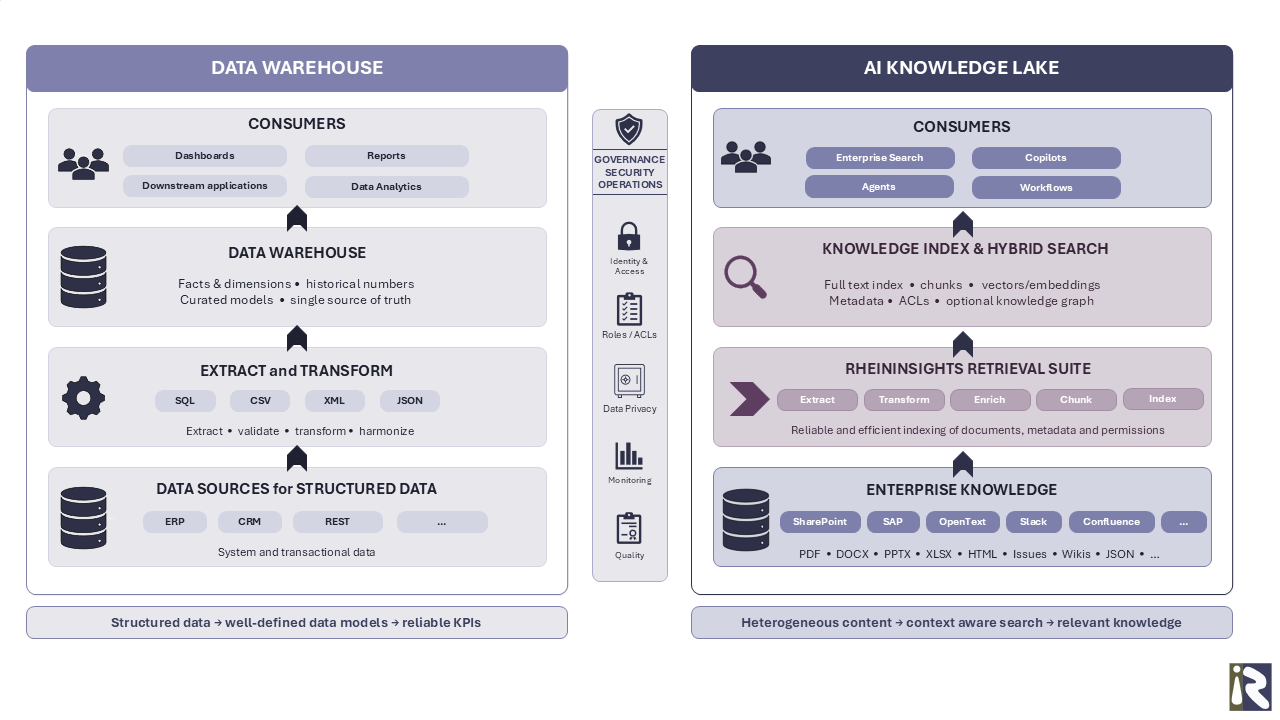
The diagram shows relationship between the classical data lake concept and AI data lakes as part of IT and AI strategies, showcasing the involved components and consumers.
This is where search and retrieval infrastructures come into play, whether they are based on classical search engines or vector databases. Based on enterprise knowledge, users get answers to their questions. Entry points include chat solutions and classical search interfaces. At the same time, AI agents also get quick access to relevant organizational knowledge, while user permissions in the original content sources are taken into account (see Permission-Based Retrieval Augmented Generation).
Due to central governance around the search platform, a common retrieval standard is maintained across the platform. Instead of heterogeneous MCP responses with varying quality, depending on the respective MCP servers, the AI knowledge lake provides homogeneous quality because the search schema, inference models, embeddings, lemmatization and linguistics, translations, document understanding, and more are maintained centrally for all integrated sources. Monitoring, security, access controls, and additional roles are also maintained centrally.
In turn, AI knowledge lakes based on search engines and vector databases are a central pillar of many companies’ AI strategies.